THE ALPHABET WHEN YOUNG

Below is my copy of the document, a drawing which attempts to reconstruct the characters that have been blurred. It is not a complete representation, as the letter Z is not shown, but it can be seen on the photographs in the lower right corner; it is easily overlooked because it so large (!). Find the mark of Zorro (but reversed) there; the original Z is made from two triangles (|><|).

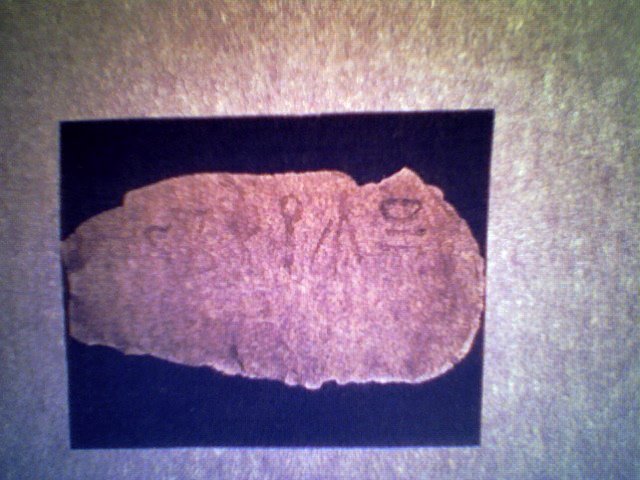
Thebes Inscription 1 (the signs of the proto-alphabet)
This remarkable artefact was published by W. M. Flinders Petrie in 1912; he did not understand its significance, and it has been ignored ever since. It appears with five other photographs of similar pieces as the frontispiece of his book The Formation of the Alphabet.
Petrie described them as "Egyptian ostraka with foreign signs", and he assumed they were from the time of the 19th Dynasty (early Ramessides, 13th Century BCE), because he noted that work was being done at that time in the Ramesseum (memorial temple of Ramesses II), and this was a possible source, though the Valley of the Kings was also being excavated.
They were among dozens of others (with Egyptian hieratic inscriptions) that he acquired from a dealer in Qurneh (ancient Thebes).
Here is another inscription from the same source (which I will designate as Thebes 4, giving the title Thebes 1 to the tablet which depicts the proto-alphabet, reproduced above); we may presume that this is a text conveying a short message, in an ancient Semitic language..
Thebes inscription 4

Our first exercise can be a comparison between the markings on the two tablets, in an attempt to match up the signs on Thebes 4 with their counterparts in the collection on Thebes 1, and identify each letter.
The character with two dots above it (third from the left) is Q, I suggest. It is the same as the Egyptian hieroglyph classified as V24, which depicts a cord wound around a stick (like the string wound on a pencil that is used by builders in our times). There is an alternative form (V25), which has two protruding strokes at the top, one for the end of the stick, the other for the end of the string. It seems to me that this V25 version is found in the middle of Thebes Inscription 1 (the proto-alphabet), as shown on my drawing, but the photograph is murky.
In my opinion this character stands for Q because the West Semitic word for a "string" or "line" is qaw. In the Hebrew Bible the word qaw is used to denote a measuring-string. In 1 Kings 7.23, for example, there is a description of the metal water-reservoir in the Jerusalem Temple: it was ten cubits in diameter, and thirty cubits in circumference, as measured by a line. Incidentally, the ratio here is not right: it is 3 to 1, but the accurate ratio is "pi" (3.1415...). Here is a problem for those who believe that the Bible is "inerrant". I guess we have to blame this error on King Solomon's artisans and architects, who were not capable of making precise measurements.
The picture of a qaw (a line on a stick) represents the sound Q by the acrophonic principle (acrophony): the initial consonant of the word is the sound the letter represents. All the letters of the proto-alphabet had their origin in this way: acrophonically.
Thus D is a door (Dalt, which became Greek Delta); it is the fourth letter from the left (a door with its jamb) at the top of Thebes 1.
K is a hand (Kap, Greek Kappa); a three-finger version (as on Maaori carvings here in Aotearoa / New Zealand) is found in the second column from the left. It is sitting on an eye, the letter `ayin ("eye"), which became the Greek and Roman sign for the vowel O, but represented a guttural consonant in the Semitic alphabet. There is an instance of K on Thebes 4, you will notice. Hebrew kap means the palm of the hand, and some of the instances look like a palm-branch (kippat), so there may be two origins for K.
Y (Hebrew name Yod, Greek Iota, the vowel i) is also a hand (yad), but it has an arm attached to it; an instance of Y is at the bottom of the left side of Thebes 1, under the eye and the "palm" (hand or palm-branch).
P, in my opinion, is a human mouth (Hebrew pe "mouth"). There is an example of P to the right of the K on Thebes 4, situated above two horizontal strokes; and on Thebes 1 the P is between the D and the Q.
This two-stroke sign ( =, under the mouth on Thebes 4) represents Dh (the sound in English "this"), and it is often used for Semitic dhu, "this", in the proto-alphabetic inscriptions at the turquoise mines in Sinai. It seems to correspond to the Egyptian hieroglyph D13, used for "eyebrow(s)", and the Hebrew word for eyebrow is zayp; presumably it was dhayp in the Bronze Age (z and dh coalesced in Hebrew). On Thebes 1 it is the second sign in the first column, above what I interpret as R.
The Hebrew name for the letter R is Ro'sh, meaning "head". In this case the head (with an eye shown) is in a reclining position.
We can see that the human body provided a goodly number of the letters of the proto-alphabet: eyebrow (Dh), eye (`ayin), mouth (P), hand (K), arm (Y), and also head (R).
We may add, that the whole body was used in the sign for H (+-E ), a person jubilating or celebrating with upraised arms (hieroglyph A28), which goes with hll (as in Hebrew Hallelu-Yah, "Celebrate Yahweh"). Over time the body dropped off the character, leaving only the head and arms, which became the vowel E in the Greco-Roman alphabet. This exulting figure lurks in the gloom on the right side of Thebes 1.
Between the Q and the K, on Thebes 4, is a circle on a stem, very similar to Q but with no protrusions at the top. This looks like the sign for W. The Hebrew name is Waw, and it means a "hook" or "nail". In the Bible this term waw was applied to the hooks from which the curtains were suspended in the Tabernacle (the tent-temple in the Book of Exodus, 26.32-37, 27.10-11).
However, there may be a cross-bar near the bottom of the stem of this character on Thebes 4, and this is certainly the case on Thebes 1, on the similar sign to the left of the Q. This would be a Tet, an emphatic T (which we may transcribe as T. or Tt). My view is that Tet is the Egyptian hieroglyph F35, which represents a heart and windpipe, symbolizing "goodness" and "beauty" (presumably because our reactions to these virtues are felt in these places). The Egyptian word is n-f-r (vowels unknown), as in the name of Queen Nefertiti, and the Semitic word is Ttab ("good").
The Waw on Thebes 1 would then be the sign under the head in the first column on the left, with a very short stem.
The double-triangle sign on Thebes 4 is very unusual, but it does have a counterpart on Thebes 1 (as noted earlier); on the far bottom right, a large example can be discerned on the photograph, though it is not shown on my drawing; two of the lines, the base and the NW stroke, are black, and the other two are faded). Z has this form in the ancient South Arabian alphabet, which derives from the West Semitic proto-alphabet. Dh appears as |=| in the South Arabian alphabet (the two horizontal strokes have two vertical lines added). Z and Dh also appear together in a Sinai inscription (383, alias 375a).
The first letter of Thebes 4 may be G (a boomerang, near the head on Thebes 1) but the photograph seems to show a stem on the hook, and thus L (a crook, standing upside down beside the hand and eye on the alphabet plaque).
Accordingly, from left to right, we read: L Z QQ W/Tt K P Dh
The word p-dh (Hebrew paz, "fine gold") is possible at the end; the K could be the preposition meaning "like" or "as"; the L "to" or "for"; the W "and", or the Tt standing for ttab ("good"); and ZQ (with the two dots indicating double Q) would go with zqq, used for refining metals.
Hence: "To refine and/good as fine gold".
Note further that two more inscriptions in this Petrie collection display all the letters of the proto-alphabet (Thebes 2+3), and these can be profitably compared with Thebes 1.


